OpenFAST Coordinate Systems |
 
|
OpenFAST Coordinate Systems |
|
This section provides a series of schematics which graphically illustrate the various coordinate systems used for wind turbine modelling. Refer also to Turbine Geometry for additional information.
All of the images are reproduced from NREL's AeroDyn program documentation, with the kind permission of NREL.
•Origin: The point about which the translational motions of the support platform (surge, sway, and heave) are defined.
•xi axis: Pointing in the nominal (0°) downwind direction.
•yi axis: Pointing to the left when looking in the nominal downwind direction.
•zi axis: Pointing vertically upward opposite to gravity.
This coordinate system is fixed in the support platform so that it translates and rotates with the platform.
•Origin: Intersection of the center of the tower and the tower base connection to the support platform.
•xt axis: When the support platform has no pitch or yaw displacement, it is aligned with the xi axis (pointing horizontally in the nominal downwind direction).
•yt axis: When the support platform has no roll or yaw displacement, it is aligned with the yi axis (pointing to the left when looking in the nominal downwind direction).
•zt axis: Pointing up from the center of the tower.
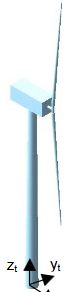
Tower-Base Coordinate System
This coordinate system is fixed to the top of the tower. It translates and rotates as the platform moves and the tower bends, but it does not yaw with the nacelle.
•Origin: A point on the yaw axis at a height of TowerHt above ground level [onshore or mean sea level [offshore]
•xp axis: When the tower is not deflected, it is aligned with the xt axis.
•yp axis: When the tower is not deflected, it is aligned with the yt axis.
•zp axis: When the tower is not deflected, it is aligned with the zt axis. It is also the yaw axis.
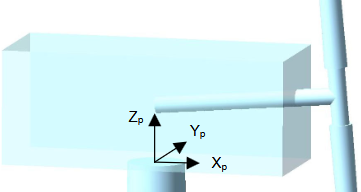
Tower-Top/Base-PlateCoordinateSystem
This coordinate system translates and rotates with the top of the tower, plus it yaws with the nacelle.
•Origin: The origin is the same as that for the tower-top/base-plate coordinate system.
•xn axis: Pointing horizontally toward the nominally downwind end of the nacelle.
•yn axis: Pointing to the left when looking toward the nominally downwind end of the nacelle.
•zn axis: Coaxial with the tower/yaw axis and pointing up.
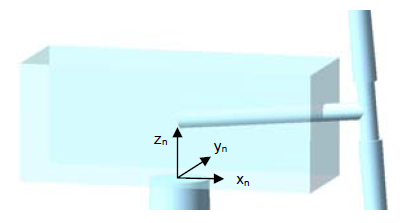
Nacelle/Yaw Coordinate System
The shaft coordinate system does not rotate with the rotor, but it does translate and rotate with the tower and it yaws with the nacelle and furls with the rotor. The nacelle inertial measurement unit uses this coordinate system for all of its motion outputs. Shaft bending moments at the hub and at the position denoted by ShftGagL use this coordinate system or the rotating hub coordinate system shown below.
•Origin: Intersection of the yn-/zn-plane and the rotor axis.
•xs axis: Pointing along the (possibly tilted) shaft in the nominally downwind direction.
•ys axis: Pointing to the left when looking from the tower toward the nominally downwind end of the nacelle.
•zs axis: Orthogonal with the xs and ys axes such that they form a right-handed coordinate system.
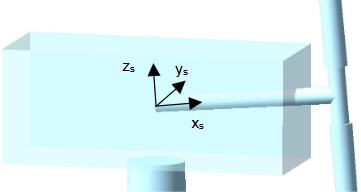
Shaft Coordinate System
The azimuth, or a, coordinate system is located at the origin of the shaft coordinate system, but it rotates with the rotor. When Blade 1 points up, the azimuth and shaft coordinate systems are parallel. For three-bladed rotors, blade 3 is ahead of blade 2, which is ahead of blade 1, so that the order of blades passing through a given azimuth is 3-2-1-repeat.
The hub coordinate system rotates with the rotor. It also teeters in two-bladed models.
•Origin: Intersection of the rotor axis and the plane of rotation (non-coned rotors) or the apex of the cone of rotation (coned rotors).
•xh axis: Pointing along the hub centerline in the nominal downwind direction.
•yh axis: Orthogonal with the xh and zh axes such that they form a right-handed coordinate system.
•zh axis: Perpendicular to the hub centerline with the same azimuth as Blade 1.
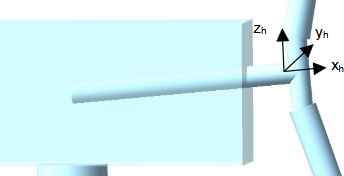
Hub Coordinate System
There is a coned coordinate system for each blade that rotates with the rotor. The coordinate system does not pitch with the blades and it also teeters in two-bladed models. For three-bladed rotors, blade 3 is ahead of blade 2, which is ahead of blade 1, so that the order of blades passing through a given azimuth is 3-2-1-repeat.
•Origin: The origin is the same as that for the hub coordinate system.
•Xc,i axis: Orthogonal with the yc,i and zc,i axes such that they form a right-handed coordinate system. (i = 1, 2, or 3 for blades 1, 2, or 3, respectively)
•Yc,i axis: Pointing towards the trailing edge of blade i if the pitch and twist were zero and parallel with the chord line. (i = 1, 2, or 3 for blades 1, 2, or 3, respectively)
•Zc,i axis: Pointing along the pitch axis towards the tip of blade i. (i = 1, 2, or 3 for blades 1, 2, or 3, respectively)
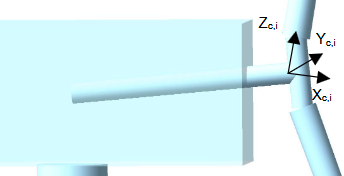
Coned Coordinate System
These coordinate systems are the same as the coned coordinate systems, except that they pitch with the blades and their origins are at the blade root. For three-bladed rotors, blade 3 is ahead of blade 2, which is ahead of blade 1, so that the order of blades passing through a given azimuth is 3-2-1-repeat.
•Origin: Intersection of the blade’s pitch axis and the blade root.
•xb,i axis: Orthogonal with the yb and zb axes such that they form a right-handed coordinate system. (i = 1, 2, or 3 for blades 1, 2, or 3, respectively)
•yb,i axis: Pointing towards the trailing edge of blade i and parallel with the chord line at the zero-twist blade station. (i = 1, 2, or 3 for blades 1, 2, or 3, respectively)
•zb,i axis: Pointing along the pitch axis towards the tip of blade i. (i = 1, 2, or 3 for blades 1, 2, or 3, respectively)
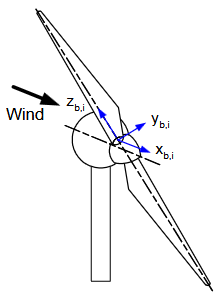
Blade Coordinate System

AeroDyn Local Blade Coordinate System (Looking Toward the Tip, from the Root) – l: Lift, d: Drag, m: Pitching, x: Normal (to Plane), y: Tangential (to Plane), n: Normal (to Chord), and t: Tangential (to Chord)